
"The practitioner's first instrument is himself. Not his hands. Not his anatomical knowledge. Himself, his capacity to remain in contact with his own nervous system.
(NeuroSpinal™ Handbook)
A method of dialogue, not correction
NeuroSpinal™ is an original somatic method based on working with the spinal axis and the nervous system. Its aim is not to correct the organism or force change, but to create the conditions in which the nervous system can start its own processes of reorganization.
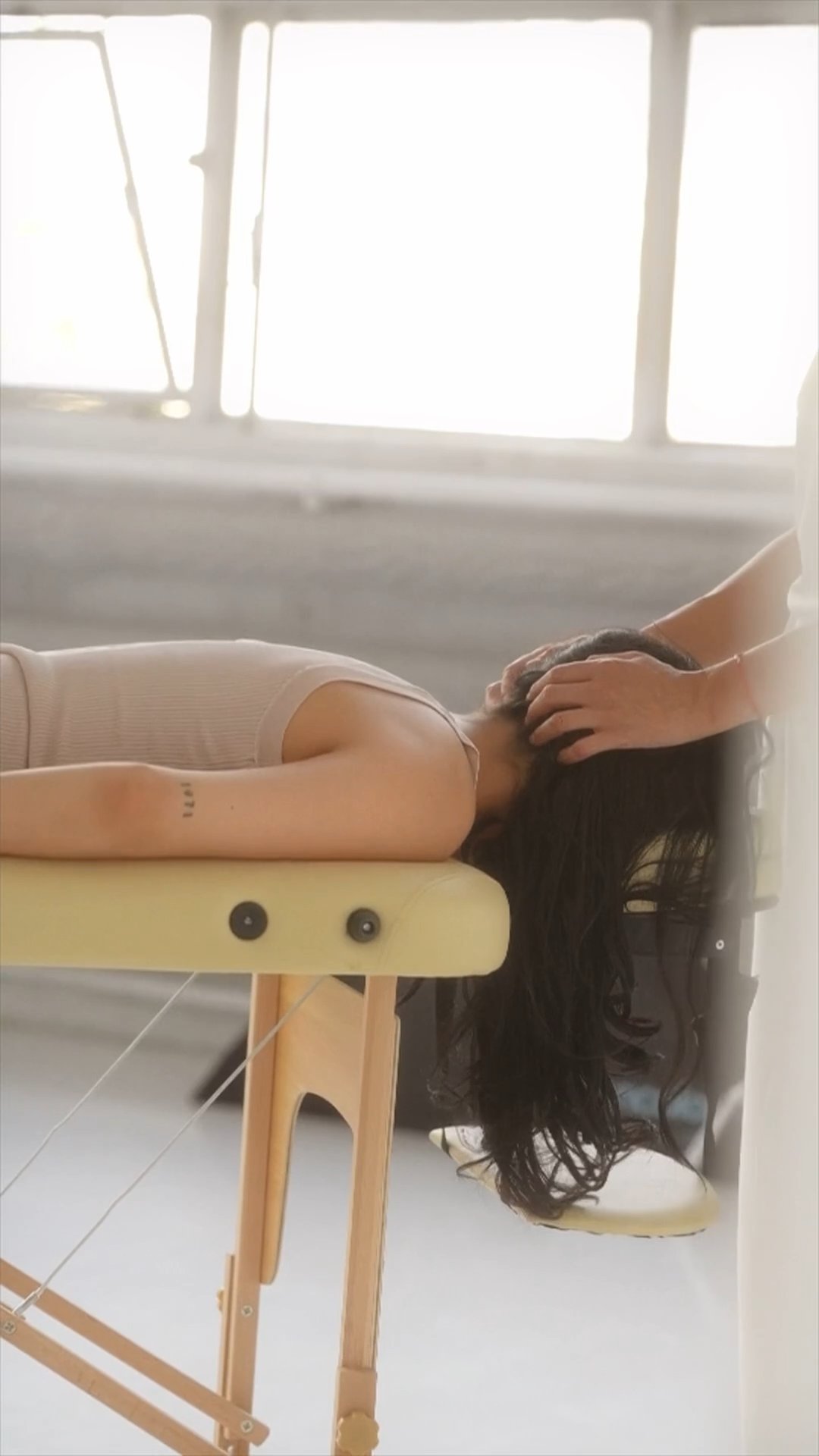
The method's point of departure is the spinal axis, a space of dialogue with the nervous system. It is here that the practitioner makes contact with the system, observing how the nervous system organizes tension, movement, and its response to contact.
NeuroSpinal™ rests on the principle of dialogue instead of correction and perturbation instead of manipulation. The practitioner does not impose a solution on the organism, nor lead it along a predetermined scheme. Through precise contact, he creates the conditions in which the nervous system can recognize new possibilities of organization and start its own processes of adaptation and reorganization.
The method integrates the achievements of contemporary neuroscience, the biology of regulation, and the body sciences into its own coherent model of work. It is not a collection of existing theories nor a simple combination of different methods. It is an original methodology developed in dialogue with science, practice, and years of observing the processes taking place in the organism.
Every element of the method has been developed in a way that allows it to be reliably taught, developed, and kept to a shared standard of practice. That is why NeuroSpinal™ is not only a method of working with a person, but also a system of training practitioners built on responsibility, supervision, and the continuous refinement of competence.
The training is open. There is one requirement.
NeuroSpinal™ requires no specific profession or diploma. It draws people working with the body, movement, breath, therapy and human development, as well as those only beginning their path with the body.
Prior experience working with the body is not a condition of entry. It is, however, something that will make the training deeper and more effective, because you already have a point of reference for the new understanding to adhere to.
(Key competence)
Listen with the whole system.
The greatest requirement is sensory sensitivity: the capacity to feel the subtle signals the body and nervous system constantly send.
Before entering the training it is worth asking oneself honestly: how well can my nervous system listen? How deep a contact do I have with my own body, not as an idea but as a living system that constantly communicates?
This is not a question with a required answer. It is an invitation to self-assessment, because a practitioner can accompany another person only as far as he himself is willing to go.
NeuroSpinal™ is not a collection of techniques to copy.
It is a path that unfolds in layers, the way the capacity to understand a human being unfolds.
You will learn to see a person not as a collection of symptoms and separate parts, but as a dynamic system that throughout life learns, adapts, and organizes itself. You will understand how the nervous system functions in regulation and reorganization, and learn to read the spinal axis as a map of tension patterns.
You will learn to work in a way where touch stops being an attempt to provoke a reaction and becomes a way of listening. You will come to know the quality of contact characteristic of the method, and learn to bring an impulse that is an invitation, not a command. You will understand why the first instrument is not technique, but the state of the practitioner himself.
You will learn to recognize the moment the system begins to take the lead, and to accompany it without haste, interpretation, or excessive interference. You will learn the principles of safely conducting a session and the boundaries of the method, to lead the work ethically and responsibly.
Training program
12 chapters arranged in four modules. Each module builds on the previous one: from the philosophy and biology of touch, through what happens during the work, to the maturity and boundaries of practice.
The handbook joins neuroscientific rigor with embodied philosophy.
What's included
(Module I)
Foundation
01
The intelligence of life
You will learn to distinguish two models of bodywork that look alike from the outside, yet lead to completely different results on the table.
02
The paradox of healing
You will discover the paradox most practitioners find only after years of their own practice, and learn to use it consciously from the very first session.
(Module II)
Biology of touch and the axis
03
Touch as a biological language of regulation
The same movement of the hand can evoke two completely different responses of the nervous system. You will learn to recognize what decides that difference.
04
The spine as an axis
Functional anatomy of the axis and biophysics. Observations of the sushumna and du-mai traditions in the language of contemporary biophysics. The axis as the place where the body pulses.
(Module III)
What happens during the work
05
Anatomy of perturbation
Your hand on the spine touches something far more precise than "the back". You will understand why the quality of contact and the place it is brought can completely change the nervous system's response.
06
The reorganizational wave
You will learn to notice the moment the organism stops responding to the practitioner and begins to follow its own intelligence, and to know when to accompany and when not to interfere.
07
Rhythm, attunement and synchronization
Two nervous systems can enter a particular kind of attunement, without a word and without effort. You will understand why the quality of the practitioner's presence shapes the process, and learn to create the conditions that favor it.
08
Neurochemistry of a session
What happens chemically in the client's body decides whether the process leads to reorganization or stops halfway. You will learn the neurochemistry of regulation and the conditions that make reorganization possible.
09
Movement and expression
The client's spontaneous movement has recognizable forms, patterns shared by every body regardless of its history. You will learn to recognize them without overwriting them with your own interpretation.
(Module IV)
Between sessions and the maturity of practice
10
Physiology between sessions
Allostatic load, interoception, and the biological processes of integration. Embodiment versus peak experience. Why the time between sessions is as important as the time within them.
11
Boundaries and dangers
The client's spiritual addiction and how to recognize it. Inflation of the practitioner's ego. Cognitive deficits from over-stimulation. When a break matters more than the next session. Supervision as a necessity, not an option.
12
The philosophy of practice
Three conditions of truth: coherence, correspondence, pragmatic value, and three layers of knowledge governed by different laws: scientific fact, practical model, philosophical intuition. You will learn not to confuse them, and understand why the "waking up" of perception and "growing up" into professional maturity are two separate processes, for the rest belongs to an intelligence older than thinking.
5 in-person days. Supervision. Certificate.
5days
In-person training
Intensive live work: the foundations of the method, perception, the quality of contact, conducting a full session. Demonstrations by instructors, practice in pairs and small groups, case analysis.
3sessions
Online supervision
After the in-person part: discussing experiences from your own practice, analysis of session processes, and support in deepening the practitioner's competence.
3years
Active Practitioner License
NeuroSpinal™ practitioner certificate and a 3-year license. After the period, the status can be extended through an update meeting.
Everything you need for certification.
-
5-day in-person training
-
Training materials
-
Three online supervision sessions
-
A period of own practice with people outside the group
-
The NeuroSpinal™ practitioner certification process
-
3-year Active Practitioner License
-
Access to the community of practitioners
(Cost of participation)
15,000 zł
net + VAT
The number of places is limited due to the practical character of the training and individual work with participants.
*Accommodation and meals billed separately (approx. 1500-1900 zł)
The training can be co-funded from external sources.
National Training Fund (KFS)
Co-funding of vocational training for business owners, the self-employed, and employees on employment contracts. Contact your Powiatowy Urząd Pracy, and we will prepare the information for the application.
Development Services Database (BUR)
Regional training co-funding programs. We plan to launch the training in the BUR system. Let us know of your interest when you apply.
0% education loan
Interest-free loans from the Ministry of Funds and Regional Policy: up to 75,000 zł, with up to 50% forgiveness. For adults resident in Poland.
Installment payments
The possibility of splitting payment into installments through an external operator. Details are shared during recruitment. Contact us if you would like to discuss options.

Philosophy of the method
i
Perturbation, not intervention
The practitioner's touch does not correct, does not repair, does not direct. It introduces a precise disturbance to which the nervous system responds according to its own logic, not the logic of the stimulus.
ii
Neuroscientific rigor
Every methodological claim has a bibliographic address. The method distinguishes three layers of knowledge: scientific fact, practical model, and philosophical intuition, and is honest about which layer it represents.
iii
The practitioner as instrument
The state of the practitioner's autonomic regulation is not an "add-on" to technique. It is a neurochemical condition of the session's effectiveness. NeuroSpinal™ first trains the capacity for self-regulation.
iv
Change happens between sessions
Reorganization happens in rhythm, not in a single moment. Each session gently shifts the state of the system, and the pause between sessions is part of the same process, not a break from it. Patience is a scientific strategy.
Not one theory. One coherent model.
NeuroSpinal™ is an original somatic method created by Sofia and Malwina, the result of years of work with clients and rigorous neuroscientific analysis.
The certification handbook has 12 chapters and over 100 bibliographic entries. The method is developed in dialogue with current scientific knowledge and years of practice. Its architecture arose at the meeting point of neuroscience, the biology of the organism, movement sciences, and the philosophy of embodiment. NeuroSpinal™ is not an extension of a single theory, it is an original model integrating many perspectives into one coherent methodology of work.
-
Training with supervision and an active community of practitioners
Frequently asked questions
Is this training for me?
Yes, if you want to understand a human being more deeply than through the lens of techniques and procedures. NeuroSpinal™ is for people who want to develop their way of thinking, the quality of their presence, and the ability to work with the nervous system.
Do I need experience in bodywork?
No. The training is open both to people with experience in bodywork, movement, therapy and human development, and to those just beginning their path. We do not require a specific profession or prior preparation. We require readiness to learn, responsibility, and attentiveness.
Will I be able to conduct sessions after the training?
Yes. The program is designed to prepare you to conduct sessions independently to NeuroSpinal™ standards. A practitioner's development does not end with the last day of the training, which is why supervision, your own practice, and the certification process are an important part of the program.
How does NeuroSpinal™ differ from other bodywork methods?
NeuroSpinal™ does not focus on correcting the organism or performing set techniques. Its point of departure is working with the spinal axis as a space of dialogue with the nervous system, and creating the conditions in which the organism can start its own processes of reorganization.
What does the certification cover?
The process covers completing the training, your own practice, participation in supervision, and meeting the standards required for the certificate. On completion, the participant receives the NeuroSpinal™ Practitioner Certificate and a three-year Active Practitioner License.
Can I conduct sessions commercially?
Yes. Certified practitioners with an active license may conduct NeuroSpinal™ sessions under the terms of the license granted upon completing the program.
Why is the license renewable?
NeuroSpinal™ is a method that is continuously developed and refined. The license maintains a shared standard of practice, access to updates, and the community of certified practitioners.
Why does NeuroSpinal™ last only 5 days?
Five days of training are the beginning of the process, not its end. The most important part of learning begins when the participant starts to work, observe, and integrate the experience independently. That is why the program also includes supervision, your own practice, and the certification process.
Start with a conversation
Every edition begins with an individual online conversation, not a sign-up form. It is a shared space in which we check whether this path and this moment are right.
(Book a call)
Leave your name and email and we will get back to you to set a time for the conversation. We usually reply within 48h.